

Presentation
Brian Peck and Canada’s First Airmail Flight: Montreal to Toronto, 1918
On June 24, 1918, Captain Brian Peck landed at Toronto’s Leaside Aerodrome with a bag of mail from Montreal. The journey became a landmark in Canadian aviation and postal history, remembered as Canada’s first airmail flight.
In The First Air Mail Flight in Canada, H. Robert Galway explores this pioneering undertaking through photographs, newspaper accounts, postal artifacts and commemorative material. His presentation takes readers beyond the familiar date and designation to consider the circumstances of the flight, the evidence preserved by its covers and the people who have kept its story alive.
From military flying to a postal experiment
The setting was wartime Canada, where military aviation supplied the personnel and equipment for an experiment in civilian communication. Peck, a Royal Air Force captain, flew a Curtiss JN-4 type aircraft, identified in the presentation with the Canadian “Canuck.” Corporal Mathers accompanied him. Photographs of Leaside’s hangars, aircraft and military camp establish the environment from which the venture emerged, while views of the Montreal Polo Grounds identify the other end of the route.
The initiative connected aviation enthusiasts with postal officials. Montreal’s branch of the Aerial League of the British Empire arranged to use the polo grounds on Bois Franc Road at Back River as an airfield and proposed carrying mail to demonstrate aviation’s practical possibilities. Postal approval transformed the proposal from an informal undertaking into an authorized dispatch.
Wing Commander F. H. Hitchins, whose historical account is represented in Galway’s presentation, described the arrangements in “Canada’s Pioneer Air Mail,” published in The Canadian Philatelist in 1960. Deputy Postmaster General Dr. R. F. Coulter approved the proposal, and Montreal Postmaster J. E. Leonard assisted. The League’s treasurer, E. Greenwood, was authorized to act as “aerial postmaster.” A mail bag and a distinctive triangular red cachet supplied the undertaking with its postal identity.
Peck and his mechanic had first flown east from Leaside to Montreal. Hitchins’s account describes their stop at Camp Rathbun, Deseronto, before continuing to the polo grounds. The proposed mail flight would therefore use their return journey, linking a military aircraft’s movements with a civilian postal experiment. This was a demonstration of what aviation might accomplish, not the opening of a regular scheduled airmail service.
A delayed departure and a difficult return
Weather prevented the planned departure on June 23. Heavy rain delayed the morning attempt, and a flight late that afternoon ended when Peck returned after only a few minutes. The successful departure came the following morning, with the aircraft reaching Leaside late on June 24.
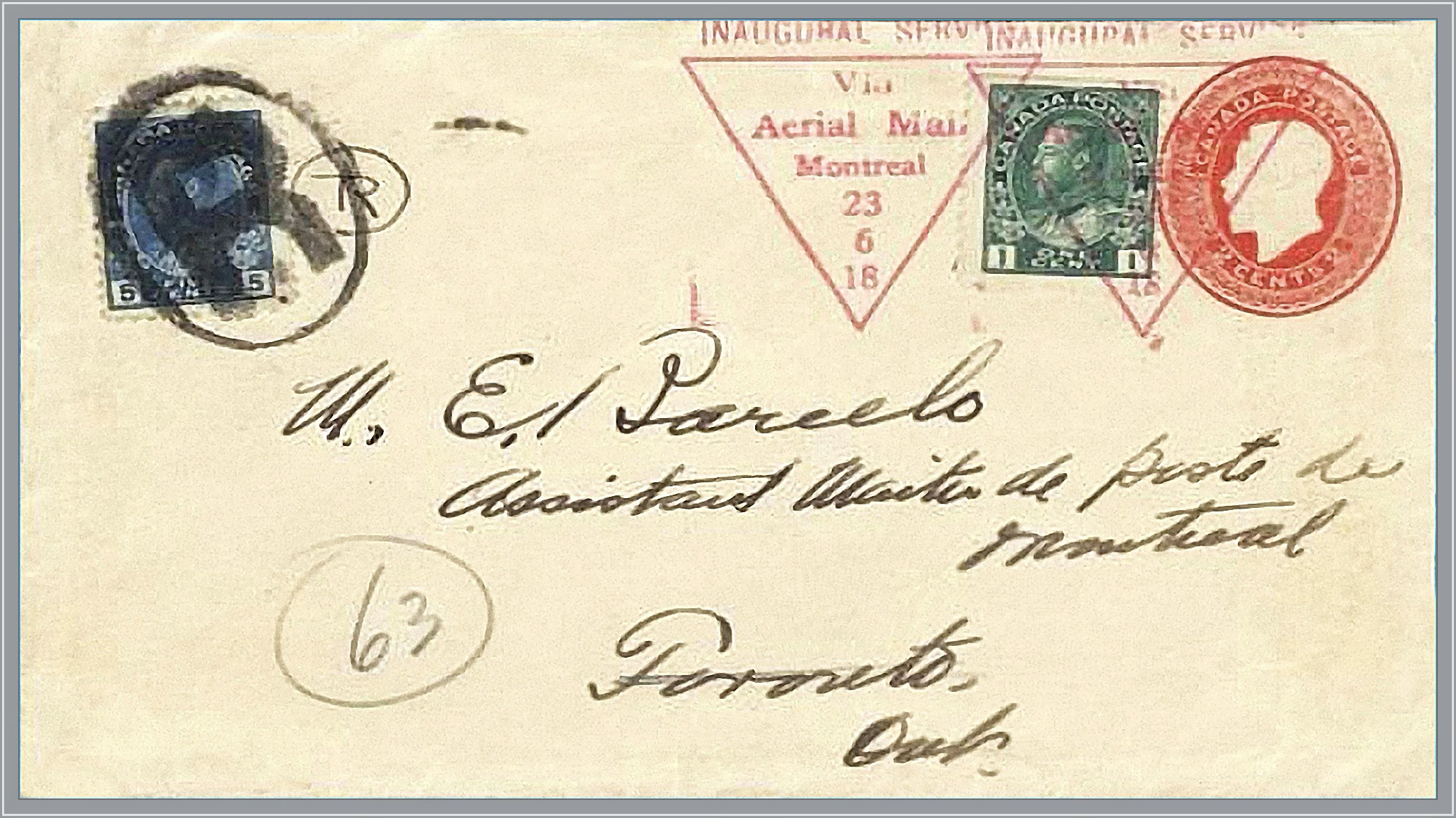
For aerophilatelists, the delay is preserved in the markings on the mail. The cover illustrated by Galway bears a triangular red “Via Aerial Mail / Montreal” cachet dated June 23, although the completed flight occurred on June 24. The distinction between the cachet date and the actual flight date is essential to understanding the cover. What might initially appear inconsistent instead records the interruption of the original plan.
The newspaper material in the presentation conveys the difficulties of the westward journey. A report headed “First Airplane Mail Here from Montreal” describes heavy wind and refuelling interruptions. Photographs and illustrations place the small biplane and its occupants within a journey whose outcome depended on weather, fuel and the limitations of early aircraft. The newspaper page also places the flight alongside wartime reporting, restoring something of the contemporary setting.
Galway includes the colourful story of a case of “Old Mull” whisky carried with the mail. Presented through later illustrative material, it belongs to the anecdotal tradition surrounding the flight. It adds a human dimension without displacing the central achievement: the successful carriage of an authorized mail dispatch between Montreal and Toronto.
The postal evidence
The mail’s journey did not end when the aircraft landed. Hitchins related that Peck took the bag by car to Toronto Postmaster W. E. Lemon so that the letters could receive an arrival postmark. Special-delivery items were distributed that evening; ordinary letters entered the regular carrier service the next morning. The experiment introduced an aerial link into an existing postal system that still handled processing and final delivery.
The illustrated cover provides a tangible connection with that process. Its postage, handwritten address and triangular cachet are evidence of an actual dispatch, rather than simply an illustration of an aviation milestone. Seen alongside photographs of Peck and the aircraft, it brings together the human, operational and postal dimensions of the story.
Hitchins described letters specially prepared for the occasion by civic, postal, railway, banking, business and Aerial League figures, together with correspondence apparently selected from outgoing Toronto mail at Montreal. The dispatch thus brought public recognition of the experiment together with the practical business of delivering letters. Its interest extends beyond the ceremonial exchange of greetings between officials.
For collectors, that account suggests the value of looking beyond the cachet alone to addresses, postal treatment and the circumstances of individual items. The presentation’s juxtaposition of original and commemorative covers also distinguishes the evidence of the flight from its later celebration. The original cover records participation in the dispatch; the anniversary cover records the importance subsequently attached to it. Both belong to the story, but they illuminate different moments in its history.
Peck’s achievement also belongs within a wider period of postal experimentation. Later in 1918, experimental flights between Toronto and Ottawa explored further possibilities for carrying correspondence by air. These were separate undertakings, but they help place the Montreal–Toronto flight in context: an early demonstration of a transport method whose practical application still required testing. Military flying experience, postal cooperation and public interest in aviation came together in these attempts to extend the uses of aircraft beyond their wartime role.
A flight remembered
Galway follows the story beyond 1918 into public commemoration and family memory. A fiftieth-anniversary cover, a historical plaque and material from the 2018 “Wings Over Leaside” centenary demonstrate the continuing interest in Peck’s achievement. Historical views of Leaside help reconnect the later urban landscape with the aerodrome that received the mail. The centenary brought that aviation heritage into focus.
The presentation closes with two contrasting contributions to the flight’s remembrance. Hitchins’s historical article appears beside Hannah Peck’s 2010 essay, “My Great-Grandfather, Captain Brian A. Peck.” The latter introduces the perspective of a descendant encountering her family’s place in Canadian aviation history. Together, they show how research and family storytelling have carried the event across generations.
For CAS readers, Galway’s presentation offers an opportunity to examine this early airmail milestone through the objects and images that preserve it. The photographs establish its setting, the newspapers convey its contemporary reception, and the covers retain its postal evidence. Together they invite a closer look at a flight whose lasting importance extends well beyond the small bag of correspondence carried to Leaside.