

Article
The “Boxed” Air Mail Hand Stamp Re-visited
Summary
Murray Heifetz classifies Canada’s “Air Mail” boxed handstamp used from 1928 onward, cataloguing type variants by lettering, size, frame breaks, colour, cities, and earliest recorded dates.
—
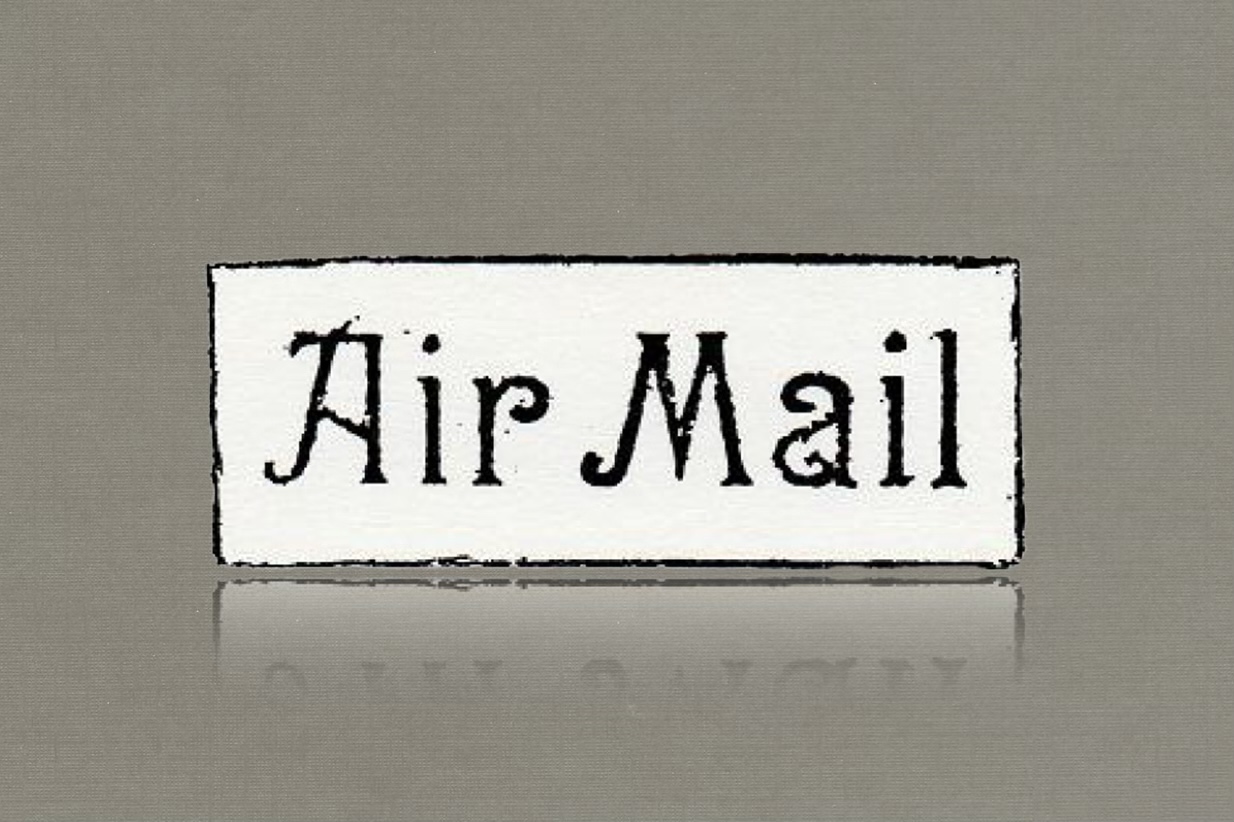
Canadian domestic airmail service properly began in 1928, when the Post Office launched contracted routes, introduced the 5¢ basic airmail rate, and issued the first 5¢ airmail stamp. Because sorters needed a quick way to identify letters that had to travel by air, senders and postmasters improvised — specially printed envelopes, “Air Mail” etiquettes, and manuscript endorsements — until, late in 1928, the Post Office authorized a standard handstamp reading “AIR MAIL” inside a rectangular box. In this March 2006 study for The Canadian Aerophilatelist — an updated version of his June 1998 article — Murray Heifetz builds the first systematic classification of that handstamp from his own collection.
Heifetz opens with the puzzle of the stamp’s production. Three hypotheses are considered: central manufacture in Ottawa (perhaps by Pritchard-Andrews, whom he tried unsuccessfully to consult); a Post Office-approved design left to individual manufacturers and stationers for retail sale; or — most likely — a Post Office-permitted design that postmasters had made locally. Usage seems to have been optional. J. Paul Hughes’s The Transportation Proof Strikes of Canada records seven proofed markings, most dating from April through December 1928, with two later “Poste Aérienne” bilingual proofs. Heifetz’s earliest cover strike is March 5, 1929, and the major period of use ran from c. 1931 to 1937, tapering off with the arrival of “all-up” airmail service that made the marking redundant. One local postmaster is reported to have still used his handstamp on personal mail decades later.
The heart of the article is the type catalogue. Variation appears in four dimensions: (1) actual letter shapes; (2) strike dimensions for the same lettering; (3) frame breaks in the rectangular box; and (4) ink colour. Heifetz assigns a Roman numeral to each frame-break design, and lower-case sub-letters to design variants sharing the same frame. Colour variants are noted in the descriptive text. He is candid about the limitations: because these are handstamps, pressure and angle of strike affect measured dimensions, so the boundaries between sub-types are inherently soft; the three sub-types of Type I may in reality be fewer.
He also flags two open questions. First, Types V and beyond use different letter styles from Types I–IV. Types I–IV align with the Post Office-proofed design; the higher types may be private, and many Type V strikes appear on covers designed by the International Air Mail Society in Montreal, suggesting that group may have commissioned its own. Second, multiple strikes on a single cover — sometimes two of the same, sometimes two colours — imply that different post offices along a cover’s route each applied their own handstamp (e.g. Vancouver → Toronto → onward air), a supposition he invites collectors to verify.
The catalogue that follows runs from Type I through Type IX (including sub-variants Ia/Ib/Ic, IIa, IIIa, IVa, Va/Vb/Vc/Vd, VIIIa), giving box and letter dimensions in millimetres, recorded colours, frame-break characteristics, the compiler’s earliest recorded date, cities of use, and remarks (thick/thin lettering, foot-of-‘M’ peculiarities, and provenance such as a Firby January 1998 auction lot). Heifetz closes with an invitation to readers to check their own material against his classification and send comments to refine it.
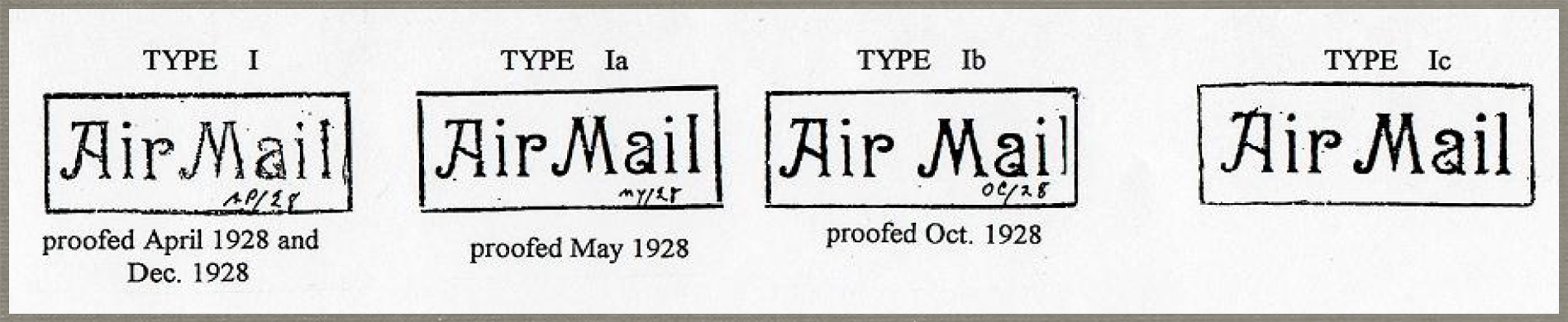
The core Post Office–proofed design and its three sub-variants, proofed between April and December 1928. Recorded dimensions (44–47 × 17–18 mm boxes; 36½–42 × 8–9 mm letters), colour range (violet, magenta, gray, blue, gray-blue, green, black), earliest cover dates (Mar 5, 1929 for Type I), and cities of use anchor the whole classification. ∎