

Article
New research on Canada’s 5 cents Air Mail rate — 1928
Summary
Chris Hargreaves resolves conflicting dates for Canada’s 1928 5¢ airmail rate, establishing August 1 for mail to the USA and October 1 for domestic service.
—
For years, philatelic literature has given conflicting dates for when Canada’s 5¢ first-ounce / 10¢ each additional ounce airmail rate came into effect — both for mail to the United States and for mail flown within Canada. Chris Hargreaves set out to resolve the discrepancy while preparing Section 17 of the revised edition of The Air Mails of Canada and Newfoundland.
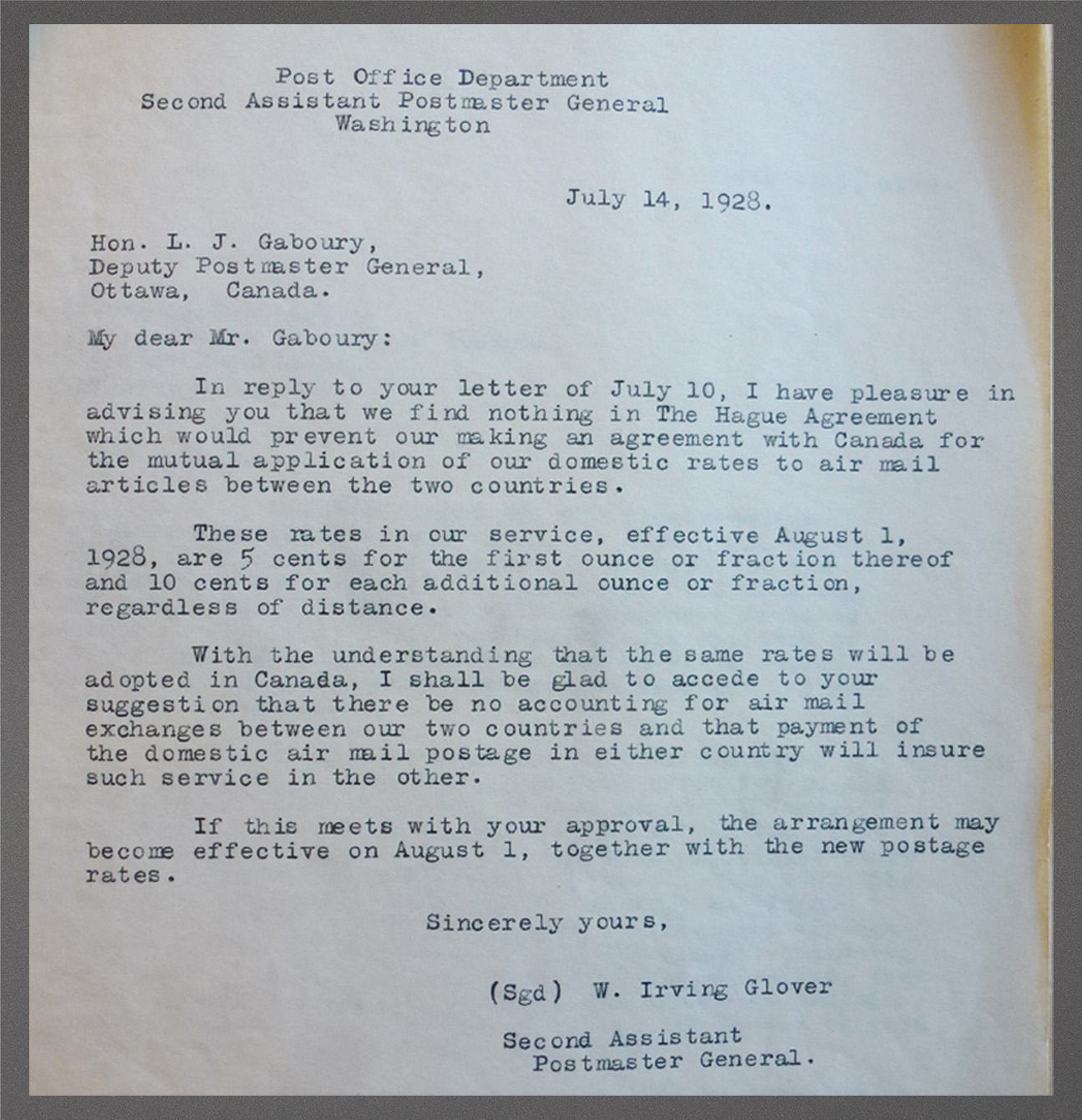
The founding document of the reciprocal agreement: US Second Assistant Postmaster General W. Irving Glover writes to Deputy Postmaster General L. J. Gaboury confirming a common 5¢ first-ounce / 10¢ each-additional-ounce airmail rate, effective August 1, 1928, with each country’s stamps accepted on the other’s air services.
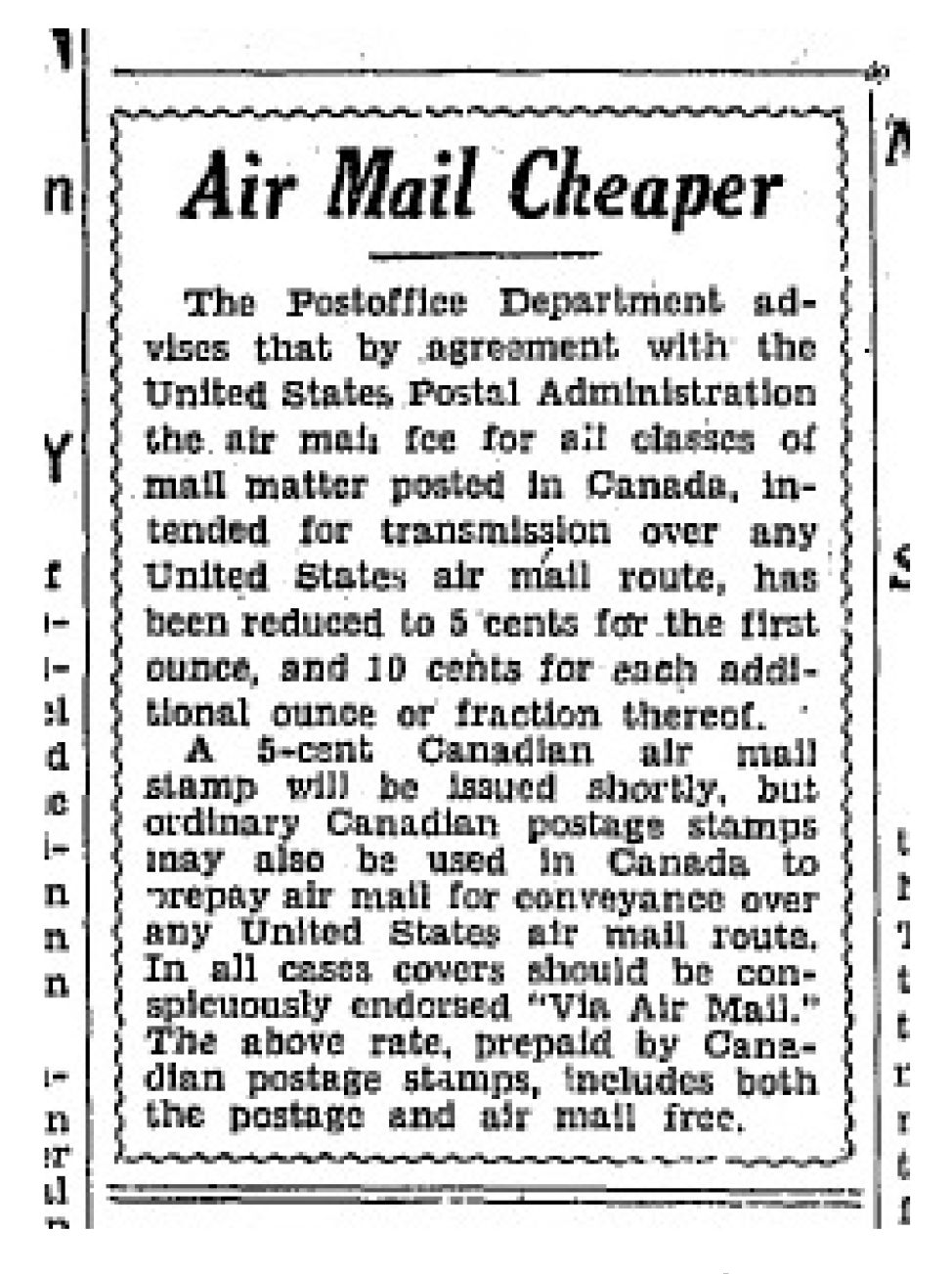
Front-page notice — written in the past tense — reporting the reduced 5¢ airmail fee for Canadian mail carried over any US airmail route. Discovered by Kathy Hartley in a digital newspaper search, this article settles the long-debated USA rate date in favour of August 1, 1928, overturning the August 7 date in the current Air Mails of Canada and Newfoundland.
At the start of 1928, a Canadian letter could reach US airmail routes only if franked with Canadian stamps for the surface leg and US stamps for the American airmail leg. Within Canada, the Post Office was already flying mail on some routes, but no surcharge was collected. In July 1928, Canada and the USA concluded a reciprocal agreement — set out in a July 14, 1928 letter from US Second Assistant Postmaster General W. Irving Glover to Deputy Postmaster General L. J. Gaboury — establishing a common 5¢/10¢ rate under which each country’s stamps would be honoured by the other.
The rate was heavily publicized south of the border and took effect on August 1, 1928. In Canada, however, the Post Office issued no bulletins to postmasters or the public, which spawned four competing dates in the standard references: Arfken and Plomish (Aug 1); Morrow and Toop, and Whiteley (Aug 7); and Robert Smith (Aug 24). The RG3 Post Office records at Library and Archives Canada and the Monthly Supplements to the Canadian Post Office Guide yielded no clarifying bulletin.
Hargreaves credits Kathy Hartley, Reference Librarian at the Vincent Graves Greene Philatelic Research Foundation’s Harry Sutherland Library, for cracking the puzzle through digital newspaper searches of The Globe. A front-page “Air Mail Cheaper” notice on August 6, 1928 — written in the past tense — confirms the reduction to the US was already in force, consistent with an August 1 effective date. On this basis, the revised Air Mails of Canada and Newfoundland will follow Arfken and Plomish and date the rate to the USA as August 1, 1928.
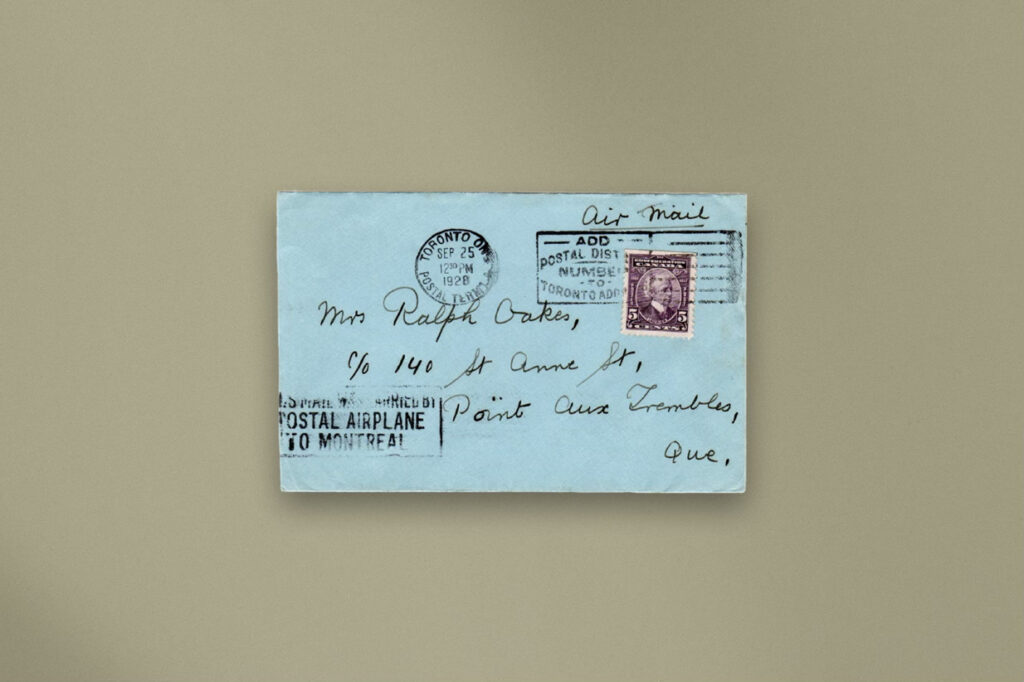
The Canadian domestic rate is a separate matter. The August 24, 1928 CNE Golden Jubilee flights from Quebec/Windsor to Toronto (and their August 29 returns) offered a souvenir cachet on covers franked 5¢, but this was a two-day promotional franking, not a required rate. Through September 1928, regular Montreal–Toronto covers can be found flown at either the surface 2¢ rate or 5¢. A Globe article of August 30 has the Postmaster-General still speaking of a future 5¢ rate “when the regular service was established,” and a September 27 Globe piece — reinforced by the October 1928 Monthly Supplement — confirms the 5¢ domestic rate was required from October 1, 1928, coinciding with the launch of the daily Montreal–Toronto service (and the Montreal–Albany route). Other Canadian routes still carried mail at the surface rate.
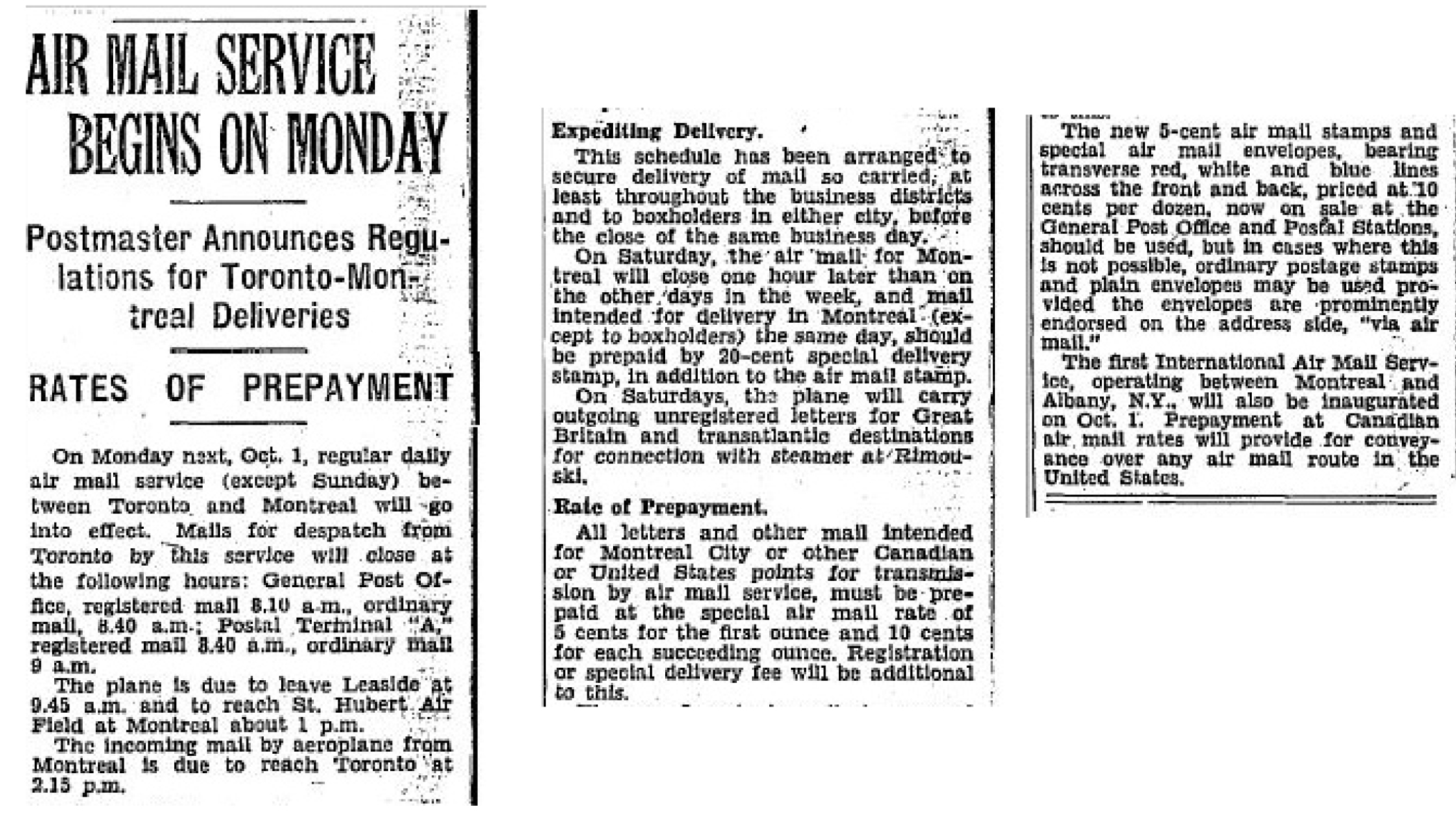
The clinching evidence for the domestic rate. The Globe announces regular daily Toronto–Montreal airmail from October 1, at 5¢ first ounce / 10¢ each additional ounce — establishing that the domestic 5¢ rate was required only from October 1, 1928, not August, and only on the Montreal–Toronto (and Montreal–Albany) routes.
Section 17 of the revised book will therefore list the domestic 5¢/10¢ airmail rate as introduced on October 1, 1928. ∎