

Article
The First Official Canadian Airmail Designation — 1928
Summary
Murray Heifetz classifies the 1928 “This Mail Was Carried by Postal Airplane” cachets of Toronto, Montreal, and Ottawa by size, spacing, and ink colour.
—
When Canada launched its first contract airmail routes in the spring of 1928, the Post Office needed a way to visibly designate that a cover had travelled by plane. Since the first regular airmail service of 1918, senders had improvised with etiquettes, “Via Airmail” or “Par Avion” endorsements, blue-and-red lozenges or stripes, and later stamps valid only for airmail. From 1927 to mid-1928 the Post Office authorized experimental flights to test air conveyance, culminating in the 5¢ airmail rate in August 1928 and the first Canadian airmail stamp that September. The specific rulebook and markings for the new services followed on the eve of inauguration.
On May 5, 1928, the Toronto Postmaster’s office issued a bulletin announcing a twice-weekly Toronto–Montreal airmail with a Rimouski connection to intercept outbound trans-Atlantic liners; Ottawa announced a once-weekly Ottawa–Montreal service the same day. Toronto’s May 5 flight was meant to meet the Empress of Scotland sailing from Rimouski; the May 12 flight was to meet the Laurentic. Because the Empress of Scotland was fog-delayed into Sunday May 6, its mail wasn’t delivered in Toronto until Monday May 7 (except for special delivery). J. H. St. Martin flew Toronto→Montreal on May 5 in a Fairchild for Canadian Transcontinental Airways; Romeo Vachon flew Rimouski→Montreal on May 6. The service cut Toronto–Montreal from 21 rail hours to 3½ air hours; Halifax’s Maritime Express CNR train fed Rimouski to accelerate Maritime mail by roughly 13 hours.
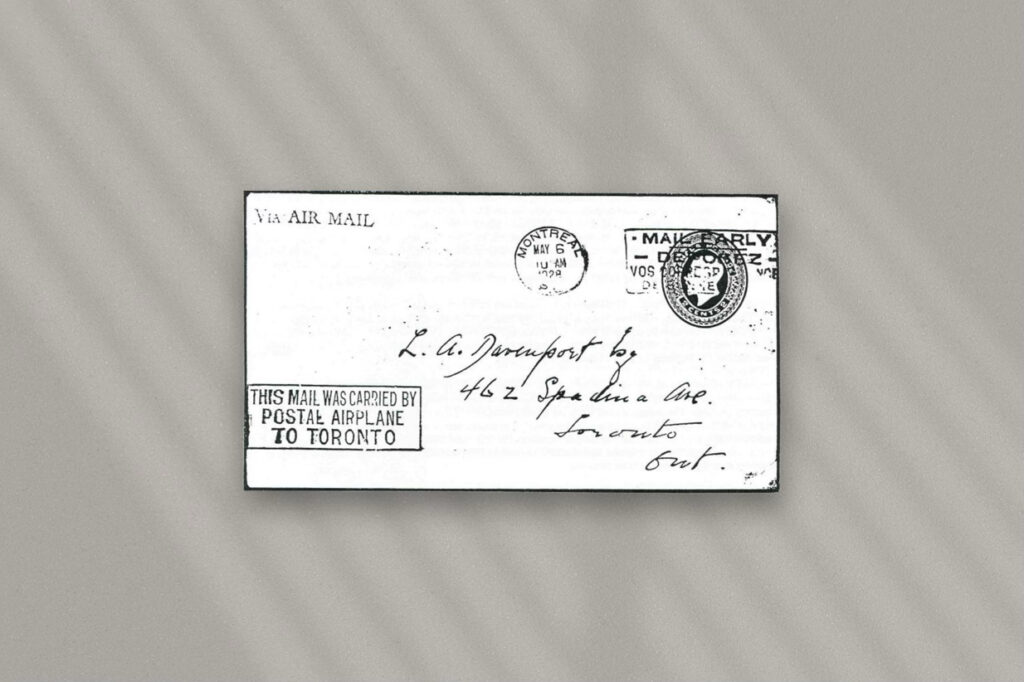
Anticipating the new services, the Post Office had cachets proofed in Ottawa in April 1928, all worded “THIS MAIL WAS CARRIED BY POSTAL AIRPLANE TO MONTREAL / OTTAWA / TORONTO” in three lines within a rectangle. Heifetz’s study — built from his own collection and a few friends’ — identifies unresolved questions about how the strikes were applied (metal hand device? roller? machine?), and who applied them, and where.
Three main types emerge, distinguished by the “K” vertical spacing dimension:
- Type I — Narrow spacing, rectangle width ~20 mm.
- Type II — Wide spacing, ~23 mm, with a period after the city name. Toronto’s bottom line is 2–3 mm longer than in the narrow version.
- Type III — Wide spacing, no period after the city name; so far only recorded on Montreal strikes.
Curiously, the proof strikes reproduced in the Robert Lee publication show only the wide spacing, yet the narrow spacing is by far the more common on covers. Ink colour is chiefly black or grayish-black, with rare violet, blue, and blue-gray strikes; one cover carries a double front strike, others are struck on both front and back.
Recorded dates run from April 26, 1928 (westbound from Perth, Scotland via Montreal) to June 5, 1929 (posted at sea). Usage lapsed between October 1928 and April 1929 with the St. Lawrence winter closure. From October 1, 1928 the Toronto–Montreal service went daily and Montreal–Ottawa–Maritimes joined it on January 28, 1929, undermining the point of city-specific cachets. A smaller boxed “AIR MAIL” marking without any city reference — proofed April, May, and October 1928 — replaced these cachets and became standard from 1929 onward. ∎