

Exhibit
Innovation in Canadian Air Mail 1927
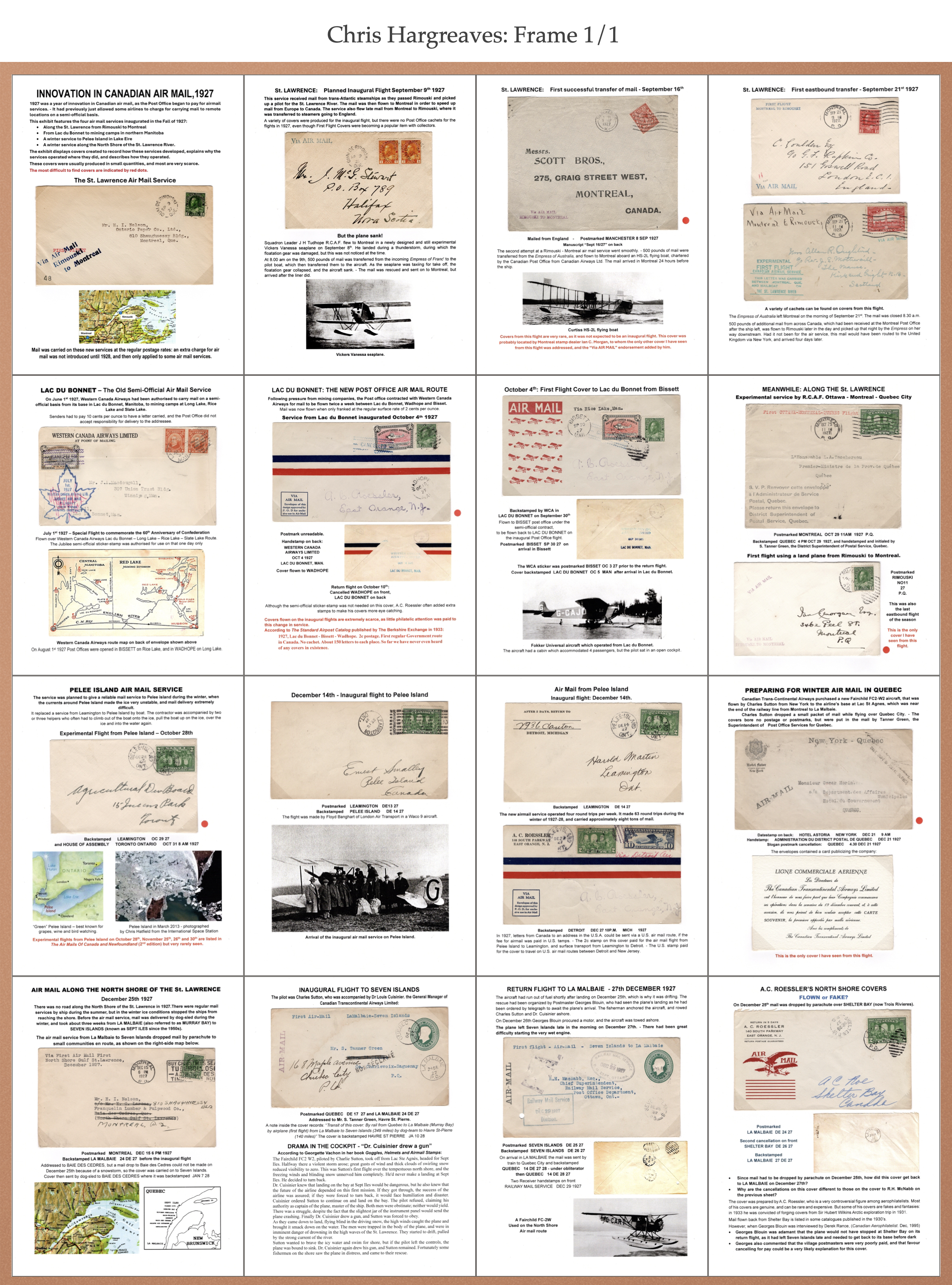
Chris Hargreaves presents this detailed account of the inauguration of Post Office services connecting with Trans-Atlantic steamships in Rimouski; from Lac du Bonnet; to Pelee Island; and along the North Shore of the Saint Lawrence.
Keywords
Canadian air mail; 1927 postal history; first flight covers; semi-official air mail; St. Lawrence air mail; Western Canada Airways; Lac du Bonnet; Pelee Island; North Shore air mail; A. C. Roessler.
Summary
This exhibit explores a turning point in Canadian postal history: the introduction of continuing Post Office funded air mail services in 1927, carrying mail without an additional air mail surcharge. Through scarce covers, postal markings, maps and aircraft illustrations, it traces four pioneering services and explains the needs behind their establishment. (Exhibit frame 1.)
The St. Lawrence service connected Montreal and Rimouski with transatlantic steamships, accelerating incoming European correspondence and allowing outgoing mail to catch vessels sailing downstream. Covers document the unsuccessful inaugural attempt on September 9, when the Vickers Vanessa seaplane sank, the successful September 16 flight, and the first eastbound transfer on September 21. (Exhibit frames 2–4 and 8.)
In Manitoba, the exhibit follows the introduction of a government-funded air stage service linking Lac du Bonnet with the mining communities of Wadhope and Bissett. Beginning on October 4, this service carried letters at ordinary surface rates, alongside Western Canada Airways’ continuing semi-official operations on other days. Inaugural covers illustrate the transition and the challenges of interpreting their postal markings. (Exhibit frames 5–7.)
The Pelee Island section shows aviation replacing hazardous winter mail transport across unstable Lake Erie ice. Covers attributed to possible experimental flights precede the December 14 inauguration. Other material illustrates onward carriage through United States air mail services, distinguishing Canadian postage from the additional American air mail fee. (Exhibit frames 9–11.)
Finally, the exhibit examines the Christmas Day inauguration of the North Shore service from La Malbaie to Seven Islands. Aircraft, parachute drops and onward transport by dog team reveal how methods combined to serve isolated communities. The concluding examination of an A. C. Roessler cover questions whether its cancellations establish carriage on the claimed return flight. By comparing postal markings with operational evidence and eyewitness testimony, the exhibit demonstrates why attractive cachets and catalogue listings alone cannot establish a cover’s history, and why interpretation remains essential to aerophilatelic research. (Exhibit frames 12–16.)