

Exhibit
Yukon Airways and Exploration Company
Steve Johnson’s updated exhibit of the Semi-Official Stamp Used by the Yukon Airways and Exploration Company
Keywords
Yukon Airways; Semi-official airmail; CL42; Stewart collection; Flight logbooks; Northern Light; Queen of the Yukon; Whitehorse; Dawson; Wernecke.
Summary
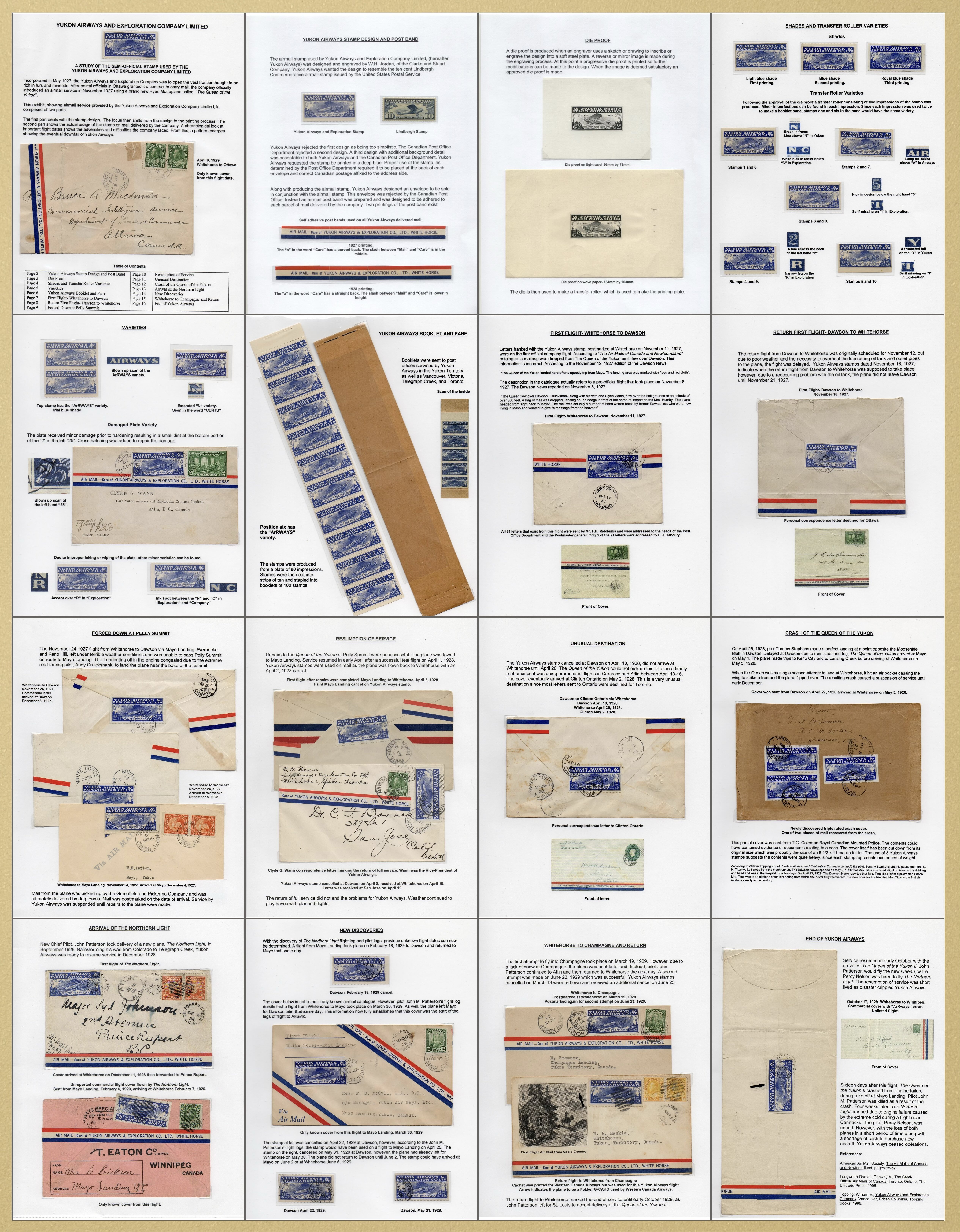
Steve Johnson’s exhibit studies the semi-official stamp and postal services of Yukon Airways and Exploration Company Limited through stamp production material and contemporary mail. Its two complementary sections move from design, printing and varieties to the stamp’s use on company flights, tracing the operational difficulties that repeatedly interrupted airmail service between 1927 and 1929. The company’s distinctive post bands accompany many of the illustrated postal items.
The opening pages compare the Yukon Airways design with the United States Lindbergh airmail stamp and distinguish two printings of the company’s airmail post bands. Displayed material includes two die proofs, three blue shades, transfer roller varieties, plate and inking varieties, and a booklet with a pane of ten stamps, linking production characteristics with identifiable positions and recurring flaws.
Postal history begins with the official Whitehorse–Dawson flight of 11 November 1927 and delayed return correspondence. The exhibit corrects an earlier account by showing that the aircraft landed at Dawson, rather than merely dropping mail; subsequent covers document the interrupted flight of 24 November, when an enforced landing near Pelly Summit led to onward delivery by dog teams.
The narrative continues with renewed service in April 1928, correspondence forwarded to Clinton, Ontario, and a surviving portion of a cover bearing three company stamps from the May crash of the Queen of the Yukon. Covers then mark the Northern Light’s arrival and resumed operations, including commercial mail from Mayo Landing, connecting aircraft history with dated postal evidence.
The concluding pages use cancelled stamps and covers to examine newly documented flights, including the March 1929 route towards Aklavik and the unsuccessful and successful Champagne attempts. A cover cancelled for both Champagne attempts illustrates the distinction between postal markings and completed journeys; the final page closes with late commercial correspondence and the company’s collapse after losing both aircraft.