

Kids Zone
The Giant Flying Boat and the Upside-Down Stamps
Age 12+
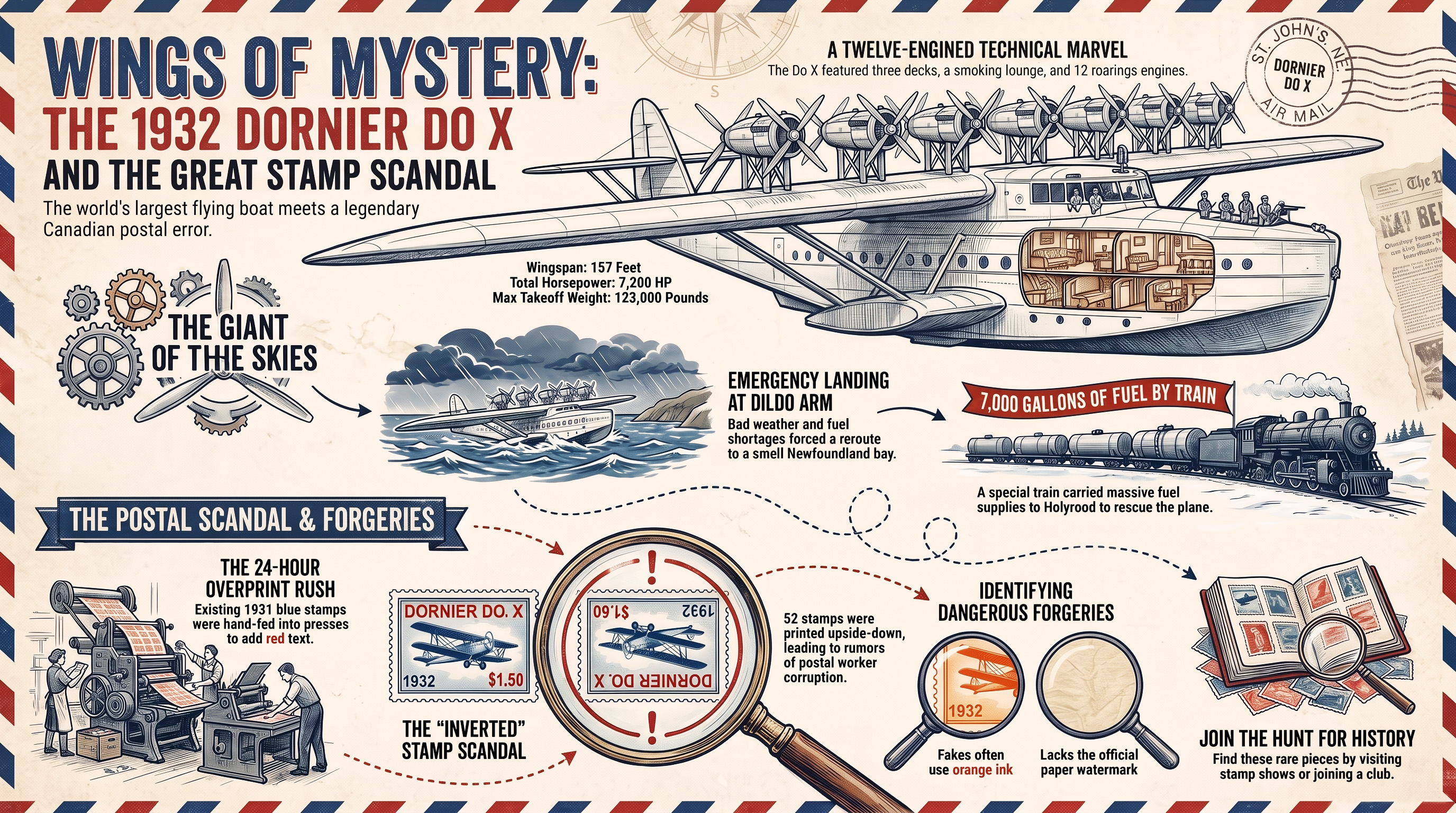
Newfoundland’s 1932 Dornier Do X Adventure
Imagine looking across a quiet Newfoundland bay and seeing something as large as a ship dropping out of the clouds. Twelve engines roar above a giant wing. Below it hangs a three-storey hull built to land on water. This is not a strange ocean liner or a machine from a science-fiction film. It is the Dornier Do X, the largest and heaviest flying boat in the world.
In May 1932, this amazing aircraft brought excitement, valuable airmail and a mystery to Newfoundland. The story would include a dangerous fuel shortage, a last-minute change of route, stamps printed in a frantic rush and rumours of postal workers secretly saving rare errors for collectors. For anyone who collects stamps, it is a story in which a tiny piece of paper becomes part of a huge aviation adventure.
The Do X had been completed in 1929. Dr. Claude Dornier designed it, and it was built at Altenrhein on Lake Constance in Switzerland. Nothing else in the air looked like it. The flying boat was 130 feet long and had a wingspan of 157 feet. It stood 33 feet high and could weigh as much as 123,000 pounds at takeoff.
Its twelve water-cooled Curtiss Conqueror engines each produced 600 horsepower. Together, they delivered 7,200 horsepower. The Do X could cruise at about 118 miles per hour and had a range of roughly 1,050 miles. It normally carried 66 passengers.
Inside, it felt more like a grand ocean liner than an aeroplane. Its three decks included a smoking lounge, dining room, sleeping rooms and a kitchen that served hot meals. Passengers could travel in comfort while thousands of kilograms of metal, fuel and machinery flew above the Atlantic. The aircraft was a technical marvel and a bold promise of what long-distance air travel might become.
The Do X began a world tour from Germany on November 3, 1930. It travelled through Europe, down the coast of West Africa, across South America and finally to the United States. The tour was meant to prove that giant flying boats could safely carry passengers over oceans. It was also a flying advertisement aimed at possible buyers, especially in America.
After reaching New York in August 1931, the Do X remained there for about nine months while all twelve engines were rebuilt. On May 19, 1932, Captain Friedrich Christiansen finally lifted the huge craft from Long Island. His plan was to fly northeast to St. John’s, refuel near the Narrows and then cross the Atlantic to the Azores.
The weather had other ideas. Conditions grew worse, and strong winds blew directly against the aircraft. The twelve thirsty engines burned far more fuel than expected. The planned landing at St. John’s was no longer safe. Christiansen had to find another stretch of sheltered water before the tanks ran dry.
At about 6:45 that evening, the Do X made an emergency landing in Dildo Arm, Trinity Bay, about sixty miles north of St. John’s. The small community had few supplies for the world’s largest flying boat. Residents gathered whatever gasoline they could spare. It was enough for one short hop, but not enough for an Atlantic crossing.
The next morning, the Do X took off at 9:20 and flew to Holyrood in Conception Bay, arriving about twenty-five minutes later. Holyrood had deeper water and better facilities. Most importantly, a railway connected it with St. John’s. Trains carried 7,000 gallons of aviation fuel from the capital to the waiting giant.
About 5,000 people came to see it, including roughly 1,000 who arrived on a special train. Imagine standing near the shore as mechanics filled the tanks and the twelve engines waited silently overhead. At 3:25 on the morning of May 21, the Do X thundered away from Holyrood. It reached Horta in the Azores later that night.
While the crew fought weather and fuel problems, another race was taking place in St. John’s. The government expected collectors to pay well for mail carried on the famous plane. On May 18, the Post Office ordered 8,000 special stamps. The Do X was expected the next day. There was no time to design and print a completely new issue.
Instead, postal officials used an existing blue one-dollar airmail stamp from 1931. In red ink, printers added new words stating that it was for the west-to-east flight by Dornier Do X in May 1932. The overprint also raised the value to one dollar and fifty cents, a very high postal charge at the time.
The printing job went to D.R. Thistle and Company, the King’s Printer in St. John’s. Its small press could overprint only four stamps at once. Sheets of fifty stamps were cut into little blocks of four, leaving strips of unused stamps behind. Workers then placed each block into the press by hand, printed the red words and removed it. They had to repeat this about 2,000 times.
The order was placed on May 18. The stamps went on sale at noon on May 19, less than twenty-four hours later. By two o’clock, a long line of buyers stretched outside the General Post Office on Water Street. The mail was limited to 3,000 letters, but 8,000 stamps had been overprinted. Selling the extras promised welcome income for the Post Office.
Speed created mistakes. Some blocks entered the press at a slight angle, producing slanted red words. On others, the overprint shifted too high or too low. The most exciting errors were completely upside down. By that evening, lucky buyers in the line had already discovered some of these inverted stamps.
About thirteen blocks of four, or fifty-two stamps, are believed to have received upside-down overprints. That was an unusually large number. All known examples are unused, and no inverted stamp has ever been found on a cover flown by the Do X. Those facts helped turn a printing accident into a postal scandal.
Rumours claimed that not every inverted block had been sold fairly across the counter. Some people suspected that postal workers had quietly kept or bought errors and later sold them to dealers. A block of four inverts could bring fifty to one hundred American dollars, almost half a postal clerk’s monthly pay. After the mail closed at 10 p.m., only staff could reach the unsold stamps.
There was never final proof of wrongdoing, and no official investigation settled the question. Some blocks may simply have been stacked the wrong way during the rushed work. Others might have been turned by a tired press operator. Yet many inverts survived, none was used on flown mail, and examples later appeared with dealers who bought stamps directly from officials. Suspicion never disappeared.
The genuine inverts became so valuable that people began making fakes. Early forgeries often used rubber stamps or hand-drawn letters. Some were printed in ink that was too bright or orange. Others were placed on the wrong kind of stamp paper, without the watermark found on genuine examples. The shape of the letter “O” in “DO-X” could also expose a fake.
For a collector, a genuine flown cover can be just as exciting as a rare error. Only about 1,700 to 1,900 covers were carried, even though the public had been told that space existed for 3,000. A real cover may show the blue stamp, the red Do X overprint and postmarks tracing its trip from Newfoundland toward Europe. Slanted overprints are known on some flown covers.
The Do X was enormous, but the evidence of its Newfoundland visit can fit in your hand. A stamp or cover connects the giant aircraft, its emergency landing, the fuel train to Holyrood, the hurried printing press and the mystery of the hidden inverts. By visiting stamp shows or joining a local stamp club, you might someday find one of these pieces of history yourself.
Source note: Written exclusively from “The 1932 Dornier Do-X Air Mail (C12): Technical Marvel and Postal Scandal.”