

Kids Zone
THE GREAT 1919 AIR RACE ACROSS THE ATLANTIC
Age 10+
Newfoundland’s Wild Spring of Airplanes, Mailbags and Stamps
Imagine standing on a windy field in Newfoundland in the spring of 1919. In front of you sits a wooden biplane with two open cockpits. Its engine sputters and coughs. A small mailbag is tied inside. Beyond the trees lies two thousand miles of cold, empty ocean. If the pilot makes it, he will land in Ireland in about a day. If he does not, no one may ever know what happened. Would you wave him goodbye?
More than one hundred years ago, no aeroplane had ever flown non-stop across the Atlantic Ocean. A London newspaper called The Daily Mail had offered a huge prize — ten thousand pounds — to the first crew to do it in seventy-two hours. World War I put the contest on hold. When the war ended in 1918, the race was back on.
Eleven teams said they would try. Only four ever took off from Newfoundland. Newfoundland was the closest big piece of land to Europe, so it became a jumping-off point for the world. Ships arrived at St. John’s carrying crated aeroplanes, mechanics, pilots and barrels of fuel. Reporters filled the hotels. Everyone waited for the weather.
The Postmaster General of Newfoundland, Dr. J. Alex Robinson, had a clever idea. If the flights were going to be famous, the mail they carried should be famous too. He decided to overprint special stamps for each attempt. An overprint is when new words are printed on top of a stamp that already exists. Robinson signed the back of many stamps with his initials, “J.A.R.,” so collectors would know they were real.
The Sopwith and the ditching at sea
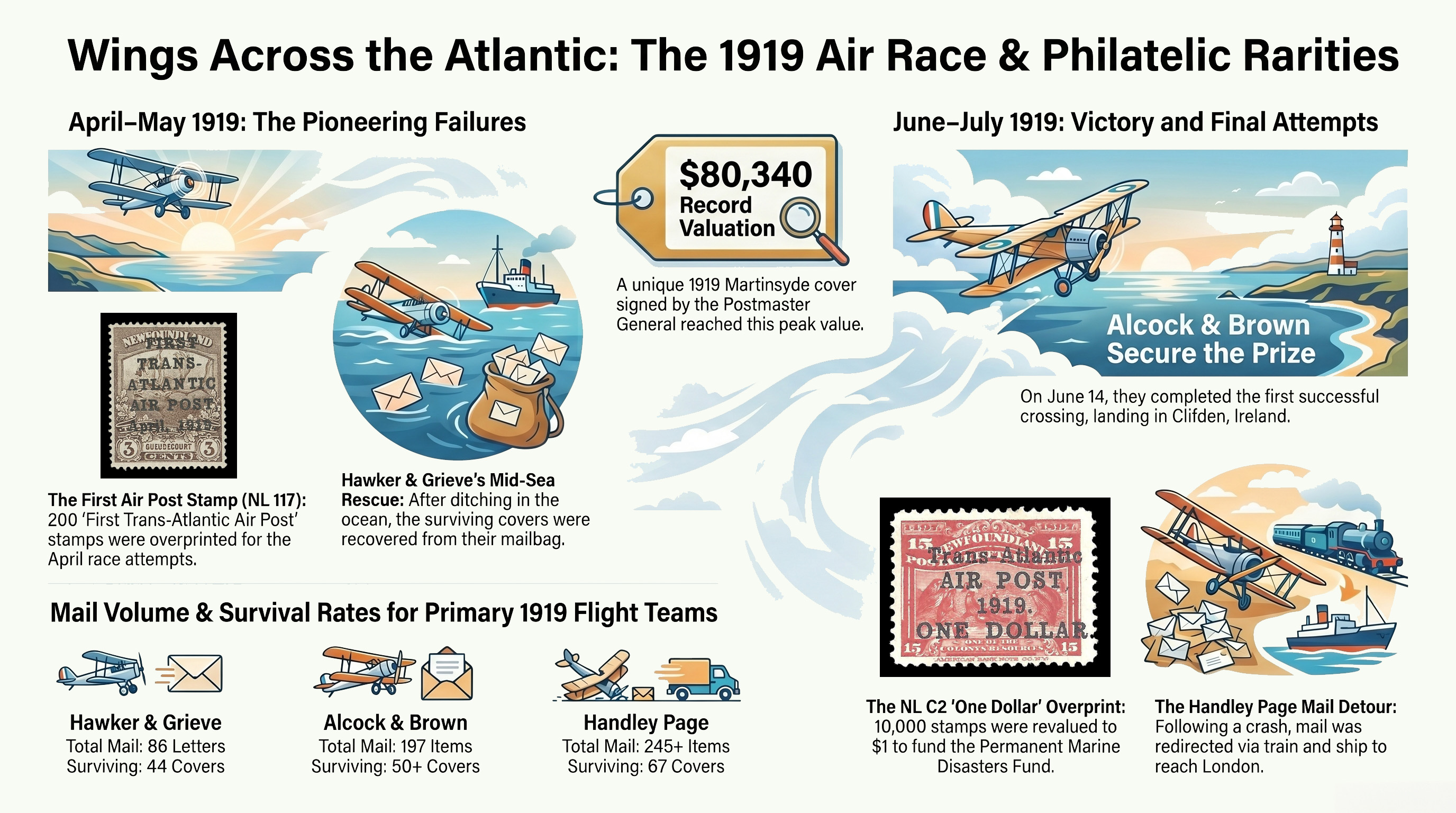
The first team was Harry Hawker and Kenneth Mackenzie-Grieve. They flew a Sopwith biplane called Atlantic. On May 18, 1919, they took off from a meadow at Mount Pearl. The Post Office overprinted two hundred three-cent stamps with the words “FIRST TRANS-ATLANTIC AIR POST. April, 1919” for their flight. Eighty-six letters and a package of photographs went into the mailbag.
The Sopwith had a single engine. About 1,250 miles out, the water that cooled the engine stopped moving properly. The airmen had to ditch in the Atlantic. Luckily, a Danish steamship called Mary spotted them and picked them up. The mailbag was pulled from the sea. When collectors look at those covers today, the stamps often show water stains — the paper actually took a swim in the ocean. The Daily Mail did not give Hawker and Grieve the big prize, but it gave them five thousand pounds for their bravery.
The Martinsyde crash on takeoff
On the same morning, Frederick Raynham and Charles Morgan tried to leave a bumpy cricket pitch near Quidi Vidi Lake in a Martinsyde biplane called Raymor. Only 50 special stamps had been hand-overprinted with “Aerial Atlantic Mail” for their flight. About thirty covers were prepared.
The Martinsyde bounced on the uneven grass, climbed for a moment, then nose-dived into the ground after only three hundred yards. Morgan was hurt by flying glass and had to sail home. The plane was smashed. Raynham was not ready to give up.
Alcock and Brown make it
While the wrecks were being cleared, a new team arrived. John Alcock and Arthur Whitten Brown had a much bigger plane, a twin-engine Vickers Vimy bomber with the bomb racks replaced by extra fuel tanks. By June, so many flights were being planned that Robinson knew the little supply of overprinted stamps would run out. So the Post Office took a stamp from 1897, revalued it to one dollar, and printed “Trans-Atlantic AIR POST, 1919. ONE DOLLAR” across it. Fifty cents from every stamp went to a fund for Newfoundland sailors’ widows and orphans.
On June 14, 1919, Alcock and Brown roared away from Lester’s Field with 197 letters and one packet. After a scary night of fog, ice on the wings and one engine acting up, they crash-landed in a bog at Clifden, Ireland, the next morning. They had done it! They won the ten-thousand-pound prize and were knighted by King George V.
The Handley Page detour
A third team, led by Herbert Brackley, Mark Kerr and Trygve Gran, had brought a huge four-engine Handley Page bomber to Harbour Grace. They were still waiting for a repair when Alcock and Brown won. Instead of quitting, they loaded 245 letters and flew south for a tour of the United States. On the way, an oil leak forced their plane down near Parrsboro, Nova Scotia. No one was hurt, but the plane needed repairs. The mailbag was sent by train to Long Island to catch a great airship called R34 for its return flight to Britain. It arrived two days late, so the mail sailed to England on the ocean liner Mauretania instead.
Raynham’s second try
Raynham rebuilt his Martinsyde and tried again on July 17, 1919, with a new navigator, Conrad Biddlecombe. This time a gust of wind caught the wing on takeoff. The plane spun into the ground and was destroyed. Both men climbed out unhurt. The mailbag was carried home by hand and eventually stamped in London in January 1920. No one tried the flight from Newfoundland again that year.
Why collectors love these envelopes
Only four teams flew, and only a few dozen letters from each flight survive. Collectors call a used envelope a “cover.” A single 1919 Martinsyde cover, signed on the back by the Postmaster General and mailed on April 19, has sold for more than eighty thousand dollars.
Not every cover from 1919 is real. A journalist named Edwin Cleary made his own fake overprint on postcards and mailed them to himself. Those are called bogus covers today. Real covers have exact postmarks, exact dates, and stamps that match Post Office records. Fakes usually get one small thing wrong — the wrong ink colour, the wrong stamp, or letters in the overprint that look slightly off.
Finding treasure
The 1919 air race lasted only three months. Four brave crews took off. Two crashed on takeoff, one ditched at sea, one crashed in Nova Scotia, and one made it all the way to Ireland. Almost every letter they carried is now a treasure. If you ever see an old envelope with a smudged red overprint and initials on the back, look carefully. You might be holding a piece of the very first Atlantic airmail.
Quick facts
- Prize offered: £10,000 by The Daily Mail
- Winning crew: John Alcock and Arthur Whitten Brown, June 14–15, 1919
- Winning plane: Vickers Vimy F.B. 27A, two engines
- First special stamp: NL C1, three cents overprinted “FIRST TRANS-ATLANTIC AIR POST. April, 1919”
- Second special stamp: NL C2, one dollar on a 15-cent 1897 stamp
- Covers known to survive: about 44 from Hawker, 20 from Martinsyde, 50 from Alcock and Brown, 67 from Handley Page
Source note: Written exclusively from Marc Castel, “The Golden Age of Aviation in Newfoundland 1919–1937 — Chapter 1: The 1919 Trans-Atlantic Air Race.”