

Kids Zone
Wings Over the Ice
Age: 10+
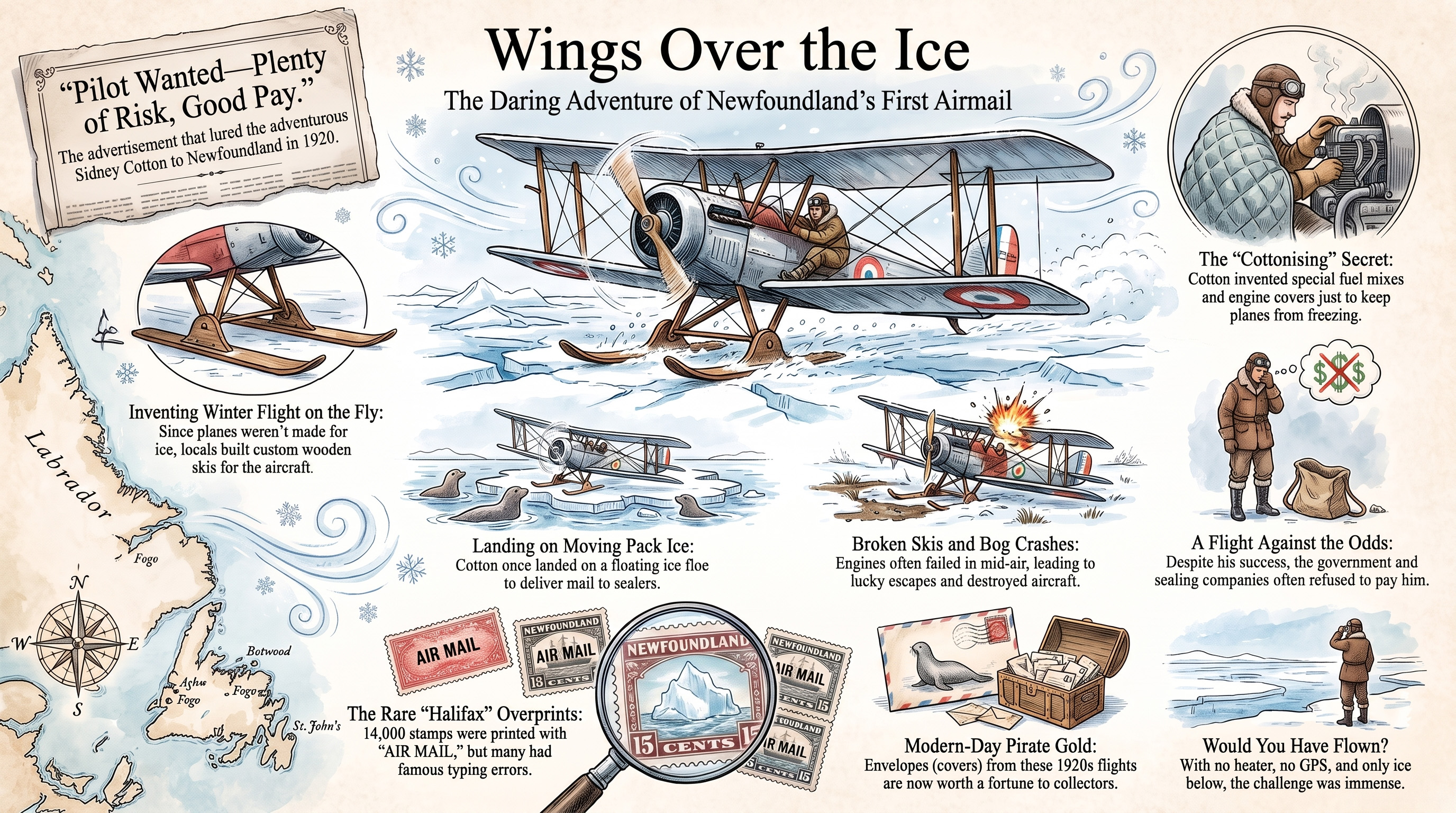
Sidney Cotton’s Great Winter Adventure
Imagine that you are standing on a frozen bay in Newfoundland. Snow blows across the ice. In front of you sits a small aeroplane with wooden wings and skis instead of wheels. Its engine coughs in the cold. A bag of letters is waiting to be loaded. Far away, people in a lonely village are hoping for news from home. The pilot pulls down his goggles. Would you climb in beside him?
More than one hundred years ago, getting mail in winter could be hard. Many small coastal villages, called outports, were far from any road. Letters travelled by ship or dog team. A trip could take weeks or even months. Storms and sea ice could stop the mail completely.
People began to wonder if aeroplanes could help. Flying was still new and dangerous. Most planes had been built for war, not for carrying letters through a Newfoundland winter. There were no weather satellites to warn pilots about storms. If an engine stopped, the pilot might have to come down on snow, ice, water or rough land.
In 1919, Major Kenneth Clayton-Kennedy brought a plan to Newfoundland. He wanted aeroplanes to carry passengers, freight and mail. He imagined a fast route from St. John’s to Montreal. He also hoped planes could find herds of seals on the ocean ice. The government liked the idea.
The post office even planned special airmail stamps. One trial design showed a plane flying over trees. The other showed an aeroplane near the Narrows at St. John’s. A trial stamp like this is called an essay. But leaders said that special airmail stamps would break world mail rules. Only a few of the essays survived.
Then the great plan began to fall apart. Airships, aeroplanes and piles of equipment arrived, but the airships could not handle Newfoundland’s winter. Workers were not paid. Sealing companies refused to keep their agreements. The flying adventure seemed finished before the first bag of winter mail had left the ground.
That was when Major Frederick Sidney Cotton took charge. Cotton was a bold pilot born in Australia. He had answered a newspaper notice that promised “plenty of risk, good pay.” There was certainly plenty of risk! Cotton formed the Aerial Survey Company and made his base at Botwood. He sent the airship crews home and decided that small planes were his best hope.
First, Cotton and his team had to teach the planes how to survive winter. A Botwood trapper named Nathaniel Hart built strong skis to replace their wheels. Mechanics made covers to keep the engines warm between flights. Cotton changed the fuel, cooling liquid and oil systems so they would work below zero.
The men had to test ideas, fix mistakes and try again. On long trips, they packed gear that could help them live through a crash landing. Every flight was a test.
The first official mail trip was planned for February 1921. About two hundred letters for St. Anthony travelled by train from St. John’s to Botwood. They carried three-cent stamps and a purple marking that said “AIR POST St. Anthony.” But a problem inside the engine kept Cotton’s plane on the ground. The letters had to go by the old surface route.
Cotton did not quit. On March 28, he took off from Botwood and flew to Fogo Island. At Seldom Come By, he dropped the mailbag onto the ice. The local postmaster, Florence Newell, went out to collect it. Imagine watching from the shore as a plane roared overhead and the village mail fell from the sky! At last, Newfoundland’s winter airmail was real.
Soon Cotton was racing between Botwood, Grand Falls, Fogo, Musgrave Harbour and Twillingate in a single day. On one trip, he could not reach St. John’s. He dropped the mail at Norris Arm, where it continued by train. Cotton had to make quick choices whenever the wind, ice or engine caused trouble.
Late in 1921, the post office planned a special flight to Halifax. Old red “Iceberg” stamps worth thirty-five cents were printed with new words: “AIR MAIL to Halifax, N.S., 1921.” Fourteen thousand were made. Some words had wider spaces. Some stamps had a dot after “1921,” while others did not. A few even had the new words printed upside down.
The Halifax flight began badly. On December 10, the skis of Cotton’s first plane broke through the harbour ice. He changed planes and took off with Captain Victor Bennett. Near Deer Lake, the engine stopped. Cotton hurt himself while trying to restart it by turning the propeller with his hands. The letters finished the trip by train and ship. One month later, the same plane crashed into a bog. Bennett and his mechanic were safe, but the plane was destroyed.
In January 1922, Cotton landed on the ice of Quidi Vidi Lake while a large crowd watched. When sea ice cut off Bell Island, he dropped newspapers to the people there. He also dropped papers onto ships trapped in ice and carried bundles to train passengers stranded by snow. His plane was noisy, cold and sometimes unreliable, but it could reach people when other travel failed.
Cotton’s greatest mail trip began in March 1922. He flew north from Botwood to St. Anthony, Battle Harbour and Cartwright. On March 12, he left Cartwright with three bags of Labrador mail. After several stops, he reached Quidi Vidi that same afternoon. Mail that once needed weeks or months to travel by dog team or ship had crossed the distance in only hours.
He also flew over the moving ocean ice to look for seals. Cotton found a large herd that people called the “Cotton Patch.” He landed on a sheet of floating ice beside the sealing ship Sagona and delivered mail to its crew. Even after that success, the sealing companies were not willing to give his planes full support. The government would not promise enough money to keep the service running either.
More trial airmail stamps appeared in 1922 and 1923. They showed the famous Vickers-Vimy plane at Quidi Vidi. These beautiful stamps were never approved for use. Perhaps only two sheets were printed. The envelopes carried on Cotton’s flights are called covers by stamp collectors. Their stamps, purple mail markings and dated postmarks are like clues.
Only two examples are known from certain Labrador flights. Collectors around the world now search for these envelopes and the stamps connected with them. A worn old envelope may not look like treasure at first. Yet it may be one of the few objects that actually travelled in Cotton’s plane during a dangerous winter adventure.
Cotton flew his last recorded Newfoundland mail trip on May 16, 1923. By August, he had faced enough storms, engine failures, money problems and crashes. He closed his company and sold all five planes. However, he and his team had shown that planes could link distant communities even during the coldest months.
They had failed many times, but they always learned and tried again. If you had seen that brave little plane waiting on the ice, with a storm coming and a mailbag bound for Labrador, do you think you would have been up to the challenge?
Source note: Written exclusively from Marc Castel, “Pioneers on Ice and Air: Newfoundland’s First Airmail Service, 1919–1923,” AAMS Boston 2026.