

Presentation
Inverted Overprints on Newfoundland Air Mail Stamps
A presentation given to the Canadian Aerophilatelic Society and the BNAPS Airmail Study Group on November 2, 2024 at the Vincent Greene Foundation in Toronto.
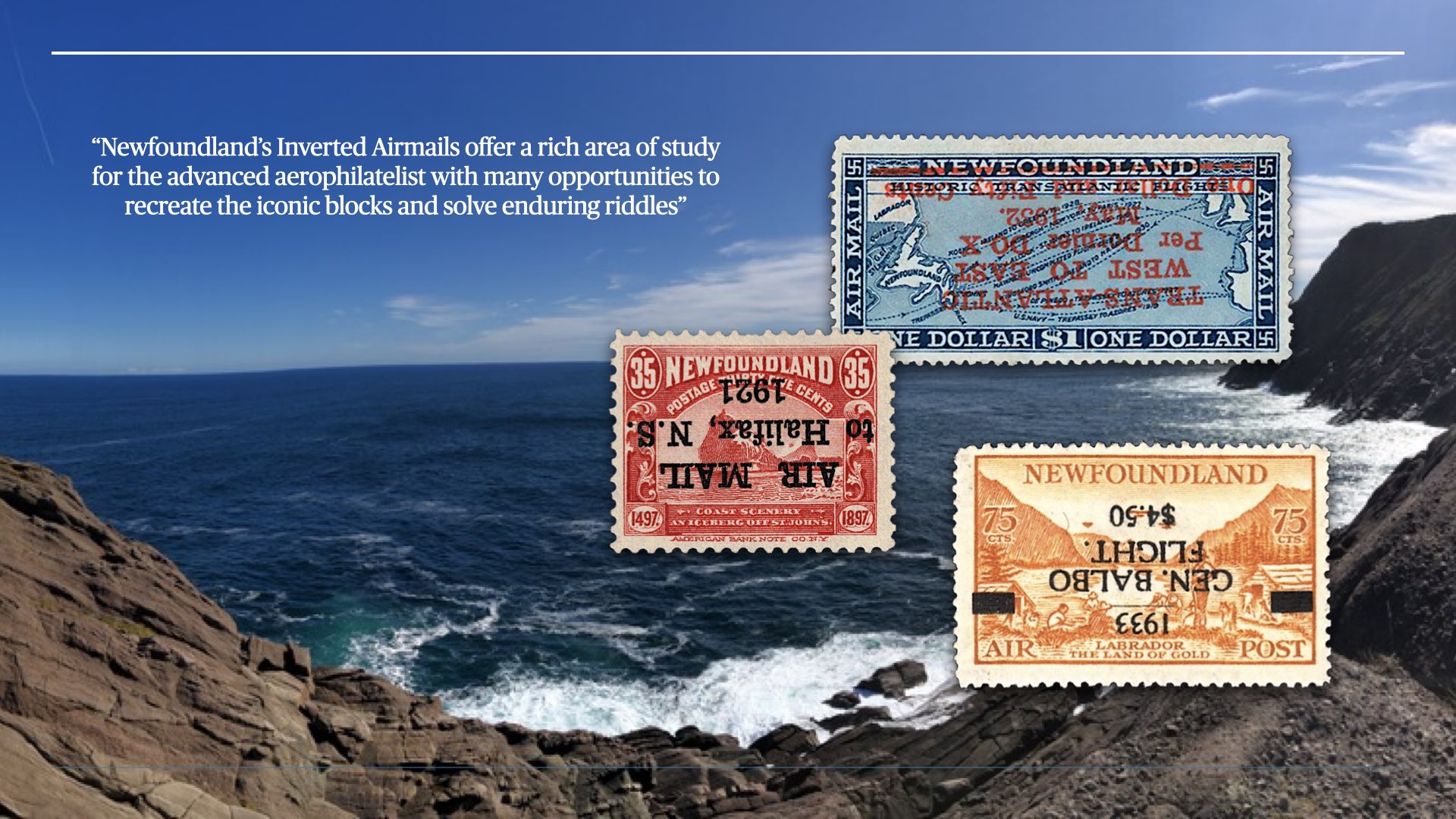
“Overprints: Newfoundland Air Mail Stamps,” examines Newfoundland’s overprinted airmail issues through three related elements: the people involved, the flights commemorated, and the stamps themselves. Its principal case studies are the 1921 Halifax airmail, the 1932 Dornier Do-X flight, and General Italo Balbo’s 1933 transatlantic air cruise. Castel concentrates especially on inverted overprints, their production, varieties, surviving material, and the unresolved questions surrounding their origin.
The presentation begins with a survey of Newfoundland’s overprinted airmail stamps from 1919 to 1933. It lists the Hawker, Martinsyde, Alcock and Brown, Halifax, de Pinedo, Columbia, Do-X, and Balbo issues, identifying the number overprinted, printing arrangements, printers, and—in three cases—the recorded inverted overprints. The Halifax issue had 125 inverted stamps, the Do-X 52, and the Balbo issue approximately 12, according to the presentation’s tabulation.
For the 1921 Halifax airmail, Castel places the issue in the context of Major F. Sidney Cotton’s Aerial Survey Company at Botwood. Cotton and Captain Victor Sydney Bennett had undertaken seal-spotting, search-and-rescue work, and limited airmail operations. The Newfoundland Post Office announced a special St. John’s–Halifax service in November 1921, authorizing up to 5,000 one-ounce letters, each requiring a 35-cent special stamp. The Royal Gazette overprinted 5,000 1897 35-cent “Iceberg” stamps on November 16; demand led to a second printing of 9,000 on November 28.
The intended flight was beset by difficulties. A Martinsyde aircraft was damaged, forcing use of an Airco DH.9B. An ice storm delayed departure until December 10. A cooling-system failure then brought the aircraft down at Deer Lake. The mail ultimately continued by rail to Port aux Basques, by the S.S. Kyle to North Sydney, and thereafter to Halifax, arriving February 4, 1922. The presentation estimates that about 5,000 items comprised the original St. John’s mail and notes a smaller Botwood supplementary mail.
Castel describes the Halifax stamp’s six principal typesetting combinations, defined by the width between “AIR” and “MAIL,” the presence or absence of a period after “1921,” and the alignment of the first numeral “1.” The first and second printings are also distinguishable by their impression: the November 16 printing is bold and deep black, while the November 28 impression is thinner and greyish black. Five blocks of 25 were inverted. Three came from the first printing and two from the second. Castel presents four distinct inverted-block types, including one with reverse offset, and discusses the possibility—clearly labelled as speculation—that the three first-printing inverted blocks may have resulted from misaligned sequentially inverted material in the feeder.
The 1932 Do-X section concerns the German flying boat’s Panamerican flight and its Newfoundland stop. Newfoundland issued 8,000 specially surcharged stamps for the event, applied in blocks of four by D. R. Thistle & Co. under time pressure. The Do-X arrived unexpectedly at Dildo Arm on May 19 because of poor weather and fuel shortage, reached Holyrood the next morning, and departed for the Azores on May 21. Castel records just over 1,800 posted cards and covers. Thirteen blocks of four carried inverted surcharges; no inverted Do-X surcharge is known on cover.
Finally, Castel considers the 1933 Balbo issue, prepared for the Italian seaplane armada’s return journey from Newfoundland. Robinson & Co. overprinted 8,000 75-cent “Labrador” airmail stamps, under supervision of the King’s Printer. Four checkers were appointed to prevent errors reaching the public, but a block of four inverted surcharges reportedly escaped detection. Castel uses auction catalogues, literature, certificates, and images to attempt reconstructions of the intact and torn inverted blocks. He also notes that alleged additional torn examples do not fit his reconstruction and could represent other sources, reconstructed fragments, or forgeries. The presentation closes by emphasizing that Newfoundland’s inverted airmails remain a rich field for advanced study, reconstruction, and further investigation