

Presentation
Cherry Red Airline: Saskatchewan’s Forgotten Pioneer Air Service 1928-1931
At the Day of Aerophilately in Toronto on November 1, 2026, Robert Galway examined Cherry Red Airline through the interconnected histories of northern aviation, mineral exploration and semi-official airmail.
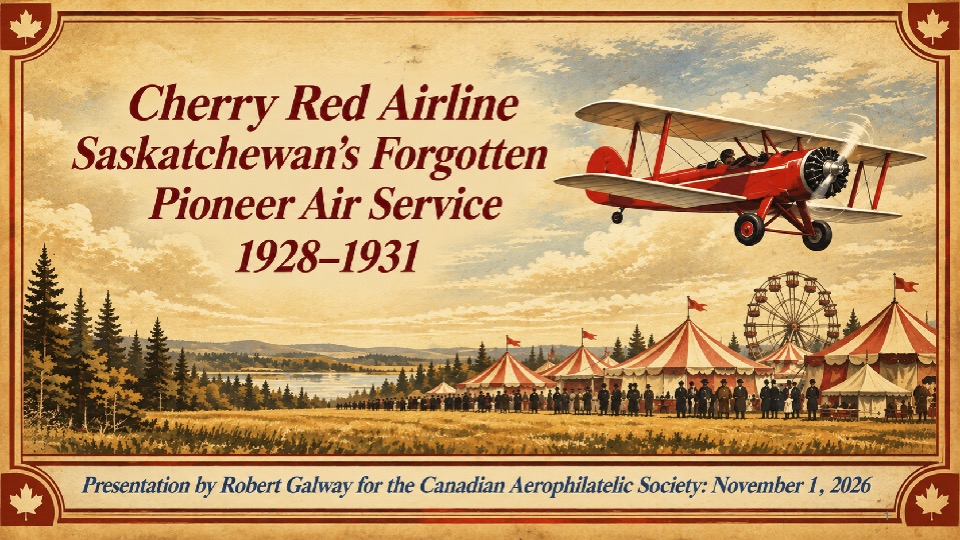
Drawing on research undertaken with Les Ostryk, Galway placed the Prince Albert enterprise within the Canadian tradition of small aviation companies serving districts beyond reliable surface transportation. Its stamps and covers preserve the postal dimension of a business whose principal opportunity lay in moving people, equipment and supplies into northern Saskatchewan.
From barnstorming to mining transport
The story began with Norman Cherry, a Saskatchewan native whose years in the United States fostered an interest in aviation. In 1928 he purchased a Pheasant H-10 biplane manufactured in Memphis, Missouri, intending to earn money through barnstorming and passenger rides. After customs delays, Cherry and pilot Alva Malone arrived at Prince Albert in May, landing in a farmer’s field between the penitentiary and St. Mary’s cemetery. Cherry was the entrepreneur rather than the pilot.
The Pheasant’s limited carrying capacity soon became a constraint. First Nations people had reported mineral showings at Rottenstone Lake, where Consolidated Mining and Smelting Company, later Cominco, took an option on the property. Access across the Canadian Shield was difficult, with lakes, muskeg and few roads separating exploration camps from established transport. Aircraft offered an alternative to lengthy overland journeys, but a machine carrying one passenger with little additional load could not adequately support the mining company’s requirements.
Cherry joined forces with Prince Albert businessman Harry Holroyde, and the partners acquired a Buhl Air Sedan, registered CF-AAY. Its enclosed cabin and greater capacity made it better suited to transporting personnel and freight. The presentation described a six-seat aircraft with a 300-horsepower Wright engine, floats, heaters and a periscope for forward visibility. The change marked the venture’s progression from public entertainment to practical northern transport.
Galway illustrated the economics of remote supply with an anecdote about flying feed to a horse at the exploration camp. The expense eventually prompted an accountant to question whether keeping the animal justified its supply costs. Beyond the humour, the episode demonstrated how geography and freight charges shaped decisions at the mine. Competition from Western Canada Airways added another pressure to the small operator’s business.
The aerophilatelic record
Mail carriage provided supplementary revenue. With Post Office permission, Cherry Red carried semi-official airmail using its own ten-cent stamps; the presentation recorded a printing of 25,000 and a charge of ten cents per ounce. Galway showed a stamp signed by Malone, linking the adhesive directly with the pilot. Rather than treating the issue in isolation, he related it to the transport needs that sustained the airline and to the wider group of Canadian semi-official operators.
The illustrated covers supplied particularly useful chronological evidence. A company envelope depicted the Buhl and accompanied a caption identifying a flight from Lac la Ronge to Christopher Lake on March 11, 1930, described as primarily a mail run. Another cover, bearing two Cherry Red stamps, represented an April 11, 1931 flight to and from Pelican Narrows. Its caption named pilot J. B. Home-Hay and recorded receipt by W. C. Rothnie, identifying the service as one of the airline’s last flights. Another cover addressed to W. R. Patton at Waskesiu Lake bore a Prince Albert machine postmark dated August 29, 1930.
These examples extended the postal story beyond the original Rottenstone undertaking. Galway also discussed destinations including Île-à-la-Crosse, Montreal River, Pelican Narrows and Lac la Ronge. The combination of company stationery, private adhesives, postal markings and signatures gave the presentation its direct connection to surviving aerophilatelic material. Crucially, the dated covers showed that the company’s history did not end immediately with the loss of its Buhl.
Aircraft loss and an enduring legacy
On October 5, 1929, engine failure forced Malone to bring the Buhl down on a small lake while carrying the Reverend Fisher and his family. The newspaper account reproduced in the slides praised the pilot’s composure: the aircraft landed but struck dead spruce at the lake’s end. The Buhl was wrecked, although everyone survived. This operational setback preceded the stock market collapse later that month and the ensuing contraction in northern mining activity.
Cherry Red was wound up in 1931, with shareholders receiving 65 cents on the dollar. Galway nevertheless identified a wider legacy in its contribution to Consolidated Mining and Smelting’s decision to establish its own air service in 1929. He described that operation as eventually owning 25 aircraft over time, extending aviation’s role in exploration and corporate transportation.
The Pheasant survived, entering the Western Development Museum’s collection in 1950 and ultimately being restored for display at Moose Jaw. Together with the stamps, covers, photographs and documentary records, it preserves a tangible connection with the enterprise. Galway’s account showed how a short-lived airline could leave evidence of lasting significance, both for Canadian aviation history and for collectors reconstructing the practical circumstances behind semi-official airmail.
Keywords: Cherry Red Airline, Robert Galway, Norman Cherry, Harry Holroyde, Alva Malone, Saskatchewan aviation, Prince Albert, Canadian semi-official airmail, Aerophilately, Airmail stamps, Flight covers, Bush flying, Pheasant H-10, Buhl Air Sedan, CF-AAY, Rottenstone Lake, Northern mineral exploration, Consolidated Mining and Smelting, Pelican Narrows, Western Development Museum
Notice: The slide presentation was created using AI Gemini Notebook from original source material.